
GreatLakesCruises.com is a sales agent for every cruise line that operates on the Great Lakes.


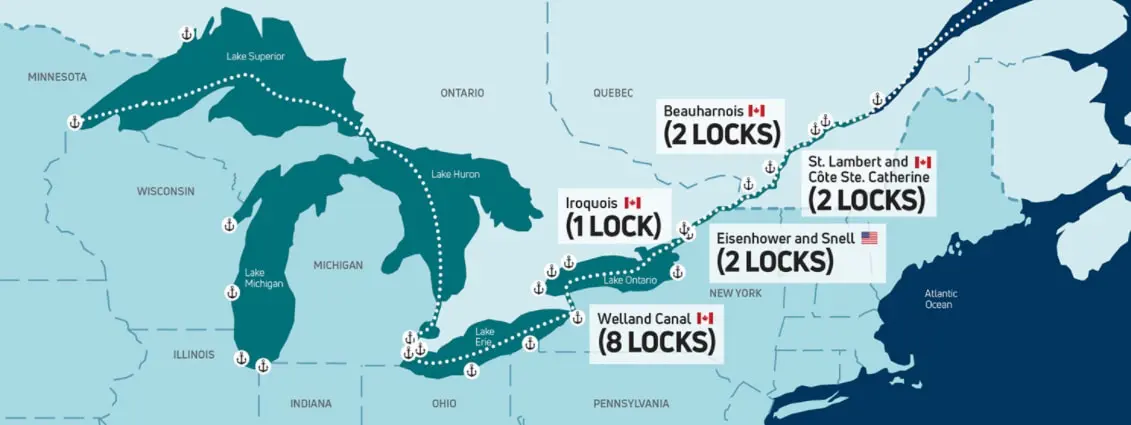
St. Lawrence Seaway cruises take travelers along the world’s longest deep draft commercial waterway, which connects the Great Lakes to the Atlantic Ocean. Besides its commercial traffic, the St. Lawrence Seaway is the gateway for Great Lakes cruises sailing to and from New England and North America’s East Coast.
Lake Erie is well-known for its breathtaking lighting displays, but this lake and its beautiful scenery weren’t made in a day. Lake Erie’s history goes back to the end of the ice age. What used to be ice-sheet-covered territory turned into basins that later filled in with water as the ice melted. The ice sheet that covered what’s now Lake Erie was thin in comparison to the rest of sheets that covered the other Great Lakes. This thin ice sheet lacked erosion power which resulted in a shallow basin.

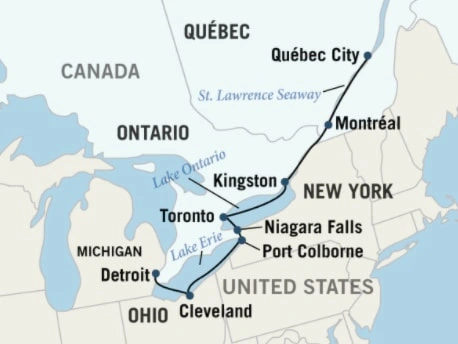
Travelers will often experience a little bit of a Great Lakes cruise before entering the St. Lawrence River. Once past the Thousand Islands and Kingston, Ontario, they’ll visit the world-renowned French Canadian cities of Montreal and Quebec City. Sailing further northeast, they’ll encounter the most natural part of the St. Lawrence, where small townships are tucked in among awe-inspiring nature. Stopping in these communities, such as Gaspe and Tadoussac, allows voyagers to explore the remote way of life and — for adventurous souls — to briefly venture into the wilderness. At the end of the St. Lawrence Seaway, guests will visit the likes of Prince Edward Island and Halifax, Nova Scotia.
Plan your visit to the Dwight D. Eisenhower Visitors’ Center at the US Eisenhower Lock at the Saint Lawrence Seaway Development Corporation website.
These seaway voyages take place on the same ships used by Great Lakes cruises, so you can be certain of a luxurious, comfortable stay that’s never too crowded. Almost all of our Great Lakes cruise lines offer trips along the St. Lawrence, delivering the same great experience as they do on the lakes.
Most St. Lawrence Seaway sailings take place in the early Spring or late Fall. This is due to the fact that they use the same ships that cruise the Great Lakes. Since the Great Lakes get so cold, and even frozen, during the winter, cruise lines move their ships to warmer waters during this time. And, what so happens to be the best way to get to and from those warmer waters? The St. Lawrence Seaway.
Opened in 1959, the St. Lawrence Seaway is the result of a close partnership between Canada and the United States, serving two Canadian provinces (Ontario and Quebec) and eight American states (Illinois, Michigan, Ohio, Indiana, Wisconsin, Minnesota, New York and Pennsylvania). Ships passing though the Seaway cross the US-Canadian border 27 times during transit, making bi-national coordination critical to its operation.
The Canadian St. Lawrence Seaway Management Corporation and the US Saint Lawrence Seaway Development Corporation work together to coordinate day-to-day operations, rules and regulations, annual operating calendar, safety and navigation technologies, as well as bilateral environmental and trade programs.
However, with increased traffic from global ports, invasive species have also crept into the waters of Great Lakes. Great Lakes fisheries are home to 177 species of fish, support more than 75,000 jobs, and are valued at over US $7 billion annually. Because of its potential impact on fisheries of the Great Lakes, the St. Lawrence Seaway has put into place sustainable management practices for ballast water to limit the importation of Aquatic Invasive Species (AIS), such as zebra mussels and sea lampreys, into the Great Lakes region
Great Lakes waterways also provide drinking water, resources and recreation to one quarter of the population of North America, making water quality is also a serious concern for governments and communities in the region.